Monday, September 12, 2011

Green Issues


A topic that is red hot in the media at the moment is the environment. We hear about global warming, energy conservation, depleting resources and recycling on a daily basis. As a child I learnt at school about gasses emitted by aerosol cans are causing a hole in the ozone layer, which can result in illnesses like skin cancer. At home that afternoon I neurotically begged my mother not to use deodorants as I feared for my life. Laughing it off because she came from a generation that was consumed by the conveniences of the post –war period, she merrily sprayed away. Besides, it would take such a long time to happen, there was no urgency in stopping then. Many years later we are facing the dilemma and all of a sudden we have switched to panic mode.
 
Green actually became a trend colour, in interiors, products, packaging and fashion. It became a visual way of reminding us to live more green. Even a large petroleum company increased its turnover, not because their product was more environmentally friendly, but because of making the public aware of its corporate colours. We now go into a supermarket buying organic products at a prime price just to ease our conscience.
 

Organic – the word also comes to mind when we talk about pottery – organic, wholesome, from the
earth – but is it really? We present our vessels to prospective buyers with a smile on our faces – ‘I
made this by hand, from the earth’ – should it then necessarily be good?
 
We work with raw materials that is actually quite hazardous. Often the fumes emitted during firing
drives us from our studios coughing and gasping for fresh air. How many of us actually wear respirators when working with glazes often containing deadly materials such as lead bisilicate or barium carbonate? In ancient times potters always outlived a few wives, who always had to decorate the pots, and the toxins from the lead used often killed them.
 
What could we do to make our craft more green? This could end up in a never ending debate, but a
few solutions come to mind. Pottery, once fired, lasts for a very long time. Archaeologists can tell the level of sophistication of a civilization merely by looking at the pottery they used, purely because it outlasts any other material. Once you made your piece, be very critical about it. If it is not your best and you are not proud of it, reclaim it before you fire it. After all, the joy is in the making. Nobody had any use for a clumsy, badly made pot that lies somewhere in a landfill.
 
Be more aware of the glazes we use. So often retail suppliers have glazes on their shelves that originates from the sixties. As long as it still sells, they will keep on producing it. A lot of these
glazes will leach toxins into food, and over the years a new generation of potters are not aware of these hazards. Be especially aware of low firing glazes that runs easily during firing, these are almost certain to contain lead and should not be used on domestic wares. Metallic glazes are often not food safe either.
 
Water is used in large quantities by potters, Disposing of waste water is often inconsiderate and it
just get dumped down the drain. Find a suitable material that will aid in settling the solids . The clear
water can then be decanted and used for watering your garden or flushing your toilet while the solid residue can be dried on plaster of paris or unusable bisque containers and disposed of in a suitable manner.
 
Raw materials always come in plastic bags or containers, which should be reused or recycled.
 

Cracked and broken pots once glaze fired can be donated to charity organisations that train handicapped or unemployed people to do mosaics. Cracked bisque ware can be used to aid drainage in container planting.
 
Electric firing is most convenient for potters and definitely cleaner burning than fossil fuels, but we need to relook our medium. A worldwide trend is to work in the mid-fire range rather than traditional high fired stoneware. A lot of industries have developed clay bodies that vitrify at lower temperatures, but studio potters are often unaware of these developments. There are some spectacular glazes available for lower temperatures, and a lot of colours, that would normally fire away at the higher temperatures, can now assure us of a brighter palette of glazes. We are still very ignorant about this in South Africa, but hopefully we will eventually see the benefit of it. We will conserve a lot of energy by firing at a lower temperature, and we could reinvent our work. If you are doing reduction firing or live in rural areas where you don’t have access to suitable electricity, consider using biofeuls to fire your kilns. It is a byproduct made from recycled cooking oil and is much cleaner burning and more sustainable than fossil fuels.
 
It would also not harm to include a green glaze in our palette, if we can not make our craft more environmentally friendly, we can at least remind ourselves to do our bit to reduce our carbon footprint.

Tuesday, June 7, 2011

Young Designers

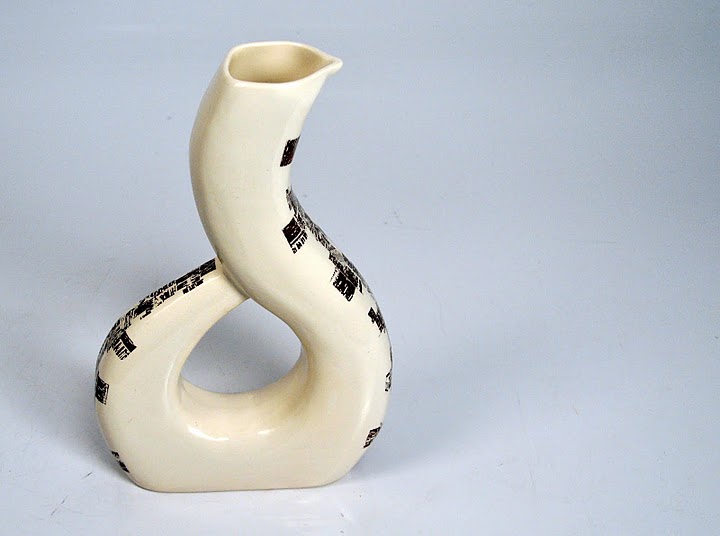
Looking at a Design Project of 3rd year Industrial Design students of the University of Johannesburg, I was excited by some innovative entries, but couldn't help noticing a few major design flaws.


The first flaw I picked up was in the mould design - the spare is a continuation of the model, and if the object ever get made by someone else than the designer, they would have no clue as where to trim it. Ideally the spare should be indented to roughly the desired thickness of the cast, then trimmed at a 45* angle in one direction and sponged in the other direction.
Trimming - although the opening is neat, there is a lip prohibiting the flow of liquid, thus accidents would be inevitable.
Purpose - is the spout sufficient to direct liquid?
Practicality - if the jug is full, would petite ladies and children be able to handle it without dropping?
 Visual confusion - the obvious direction of pour is in the same direction as the handle.
 Hygiene - how on earth do you imagine a piece like this will be cleaned?

I know my post sound negative, and I probably have put my foot kneedeep into it, but from many years experience as a commercial potter, I am flabbergasted that these  principles are sadly not stressed enough at universities, colleges or pottery schools.

I would like to encourage young (and older) designers to relook their design and ponder the issues. So often I walk into a shop and pick up a beautiful piece, then put it down again for the very same reasons. Asking the assistant about it, I get told that it sadly doesn't sell. That proves that I am not the only person thinking that way. Once that happens, you have lost the retailer as a client, which would require acrobatics to win them back again.

All photographs by Kyle Brand.

Out of the Box Fine Art & Craft Expo

DIRECTIONS

Thursday, May 12, 2011

Belle Terre

Belle Terre, French for 'Beautiful Earth,' is an exquisite range of individually handcrafted jewellery designed and made by award winning ceramist Deon de Lange.

Born with a natural curiosity has always led me to travel and explore. Embarking on several trips crossing the globe, a particularly rich source of inspiration for me, reflects as an overwhelming influence in my designs. Always carrying my camera,  I visually capture ideas. Returning from one of my travels with a mind full of ideas, I started searching for a medium to create them. Then I found clay! I experimented with this wonderful new medium often late into the night, working it into all the forms from and possibilities. Over time I refined my techniques, I read books and visited exhibitions to learn as much as I could about this exciting medium.

The beads reflect my inspiration from nature, ethnic cultures, minerals and ancient artifacts. Each piece is unique and made from ceramic, glass, metal and semi precious stones. I love combining translucent glass with textured clay and polished metal. My designs are simple, refined and pared back to their basic form. They are inspired by the amazing shapes and patterns of the natural world and the wonderfully diverse human cultures I encounter.

The clay beads are sculpted from specially developed porcelaneous body to ensure strength and durability, and fired to optimum temperature to ensure every piece can be worn with confidence. The clay, stained with colored minerals, are overpainted with slips (liquid, colored clay) which often react with future glaze layers. before firing to a high temperature.

What I love about working in ceramics is that every step of the process has it’s own character. One shape will lead me to another, I like to work on several ideas at one time. Often designs change while assembling the pieces. Soft clay is so receptive to rolling, stretching, kneading, texturing, impressing, yet it tells you when it’s had enough. There is excitement and challenges in every stage,  results after several firings are mostly unpredictable, either nerve-wracking or extremely satisfying. When fired, the clay is permanently frozen in time. Forms and colors that I create today will literally last thousands of years after being subject to the high heat.

Although I use glaze formulas that are fairly predictable in terms of color and shine in the final firing, there are a lot of other variables that make glazing an adventure. I paint many layers that blend and you cannot see the real colors until the final firing melts the glazes into a glassy coating. Abundant texture, layering of lines and shapes, and an organic quality in form characterizes each bead into a world in it’s own. Creating  different compositions to wear is exciting.

Growing up in a small town in rural KwaZulu Natal, I have been passionate about art & craft for as long as I can remember and throughout the years completed many arts-based courses involving painting, ceramics, glass and metal.  Moving to Johannesburg after school, I started working in the corporate environment. I eventually found myself missing the process of creating art and craft by hand. As a result I made the decision to leave my job and start working in ceramics full time. One of the great advantages of working from home is that I’ve been allowed the time and space to get my hands dirty and get back into making things I love.

You can view the results here.


Tuesday, April 12, 2011

Funky Finds

I found these innovative pieces on the web that appeals to my sense of humor:

Wyatt Little designed this piggy bank in the shape of a cross. Called 'Jesus Saves', it has a corkscrew piggy tail in the back. Little says, “If there is one thing everyone can agree on, its that churches are very good at raising and making money.”

Mike Mak designed these dumbbell shaped money box called 'Mo ney is Power'. The more money you put in this dumbbell, the more power you have to lift it up.

The next test results

Since my last disaster I decided to do a more extensive test this time. The first firing was to 1025*C and I used the basic principle of 50% clay and 50% glassformers, with 6%body stain mixed in to firstly see the reaction of colour in the body and secondly to distinguish the tests from one another. Here are the results:

  • A - Same body as my first test. I found the surface satisfactory, colour development was good and so the vitrification. On the downside the bead slumped in the firing and the hole was closed totally. Bead stuck slightly to test tile.

  • B - Standard glaze flux(1) . Body still very porous and colour underdeveloped. Will retest at higher temperature.

  • C - Standard glaze flux(2) . Body still very porous and colour underdeveloped. Will retest at higher temperature.

  • D - Flux used in glassmaking. Body set rockhard before drying. Surface rough and scum formed opaque layer on surface. Bead stuck to test tile. Colour development good.

  • E - Flux used in glassmaking, as above but 20%. Body set rockhard before drying. Surface rough and scum formed opaque layer on surface. Bead stuck to test tile. Colour development good.

  • F - Lucie Rie Bronze slip. Body very short, but otherwise interesting. Slightly vitrified  and nice surface. On the downside it can only be this one coolur. I will refire at a higher temperature to investigate results.

The tests were an interesting learning curve and have motivated me to take the experiments further, I will keep you posted.

Saturday, April 9, 2011

Learning from my Mistakes

Every great artist will admit that somewhere in their search for perfection they did make mistakes. The secret is not to dwell on it, but to learn and conquer.


During a recent project teaching people skills, I decided to develop a new clay body that will simplify the process. I wanted something that can be once fired, with colour included in the body and that would eliminate the glaze process, but still give the necessary sheen. I tried researching Soft Paste Porcelain, but could not track down much information, let alone any recipes. 

The next option I thought about was Egyptian paste. Looking at the drawbacks of making, handling and firing, I quickly dismissed the idea. Working with unskilled people with not a very high level of education, the attempt would have been too frustrating for me and them to turn it into a viable option.

The next thing I came across was something used in the 19th century to simulate marble, mostly used for figurines. I came across a recipe in an old book I found at a flea market many years ago, and decided to give it a try.

Working with the first test batch was very interesting. Although the body was very short, it had great green strength, which was definitely a plus point. I need to add something to increase the plasticity. During the firing process it dawned on me that with the high amount of fluxes, the temperature of 1150*C would be too high. The photograph at the top is the result, everything melted down and bloated totally. I am doing more test firings at lower temperatures, but will also experiment with other fluxes to come up with the perfect solution.

The next mistake I encountered was using platinum luster on an unglazed surface fired to a high temperature. What I envisaged as a bright matt silver colour, turned out to be a rather muted grey. Although not totally wasted,  I will not go this route again. The colour would be much better obtained from slips and engobes, as the price of the luster is too expensive to make it commercially viable.

So its back to the drawing board for me, even the smallest mundane pieces can stimulate your creativity, and hopefully great things will come from this

Friday, April 8, 2011

Trash Chic

What to do with your clay trimmings when you make your masterpieces? Instead of dumping it in the reclaim bin, (which is in most cases just a politically correct name in many studios, as it is a lot more convenient to buy a new bag of clay than slogging over the bin trying to reclaim the scraps) unskilled people are shown how to form it into these simple organic shapes.

Decoration comes from a pile of unused decals that clutter up another part of the studio. Larger motifs are treated as pieces of fabric that is cut when making a garment instead of trying to feature a realistic image. The effect is quite abstract and whimsical. Words and letters are cut up and reassembled to represent typeface, but please don’t try to attempt constructing a logical sentence from it.

These ‘Pretty Pebbles’ find their way onto leather, suede and organza, accentuated with a decorative bead, as an adorable funky piece of jewellery made from discarded materials. Judging from a few that survived having been accidentally dropped onto a concrete floor, they are very durable too!

If you just have to have one for yourself or if you want to stock a few in your store, contact Deon on +27(0)72 134 9613

Friday, April 1, 2011

Have a Heart

When I was invited to exhibit at the ʻOut of the Boxʼ Art Fair Extraordinaire, I decided to make a few heart shaped items for the occasion. With the proceeds of the fair going to the ʻOut of the Boxʼ Skills Development Centre, I decided the shape would be appropriate. The centre provide training to unemployed people to acquire basic craft skills in order for them to make items to sell as a way of sustaining themselves.

Why red? Suitably it is the colour of blood which pump through our hearts without which life would be impossible. Please support the artists exhibiting, proceeds go to a very worthy cause.

Art Fair Extraordinaire
Friday 1 April to Sunday 3 April
10H00 to 14H00 daily
305 Long Avenue
Ferndale
Randburg
Enquiries: Nina 083 583 5383

Tuesday, March 15, 2011

All that is broken is not lost!

FRAGILE Salt & Pepper Shaker 

This elegant sculpture is a ceramic salt and pepper shaker that comes in one piece and only by breaking it, you turn it into a useful product. The action of breaking leaves its mark on the shaker and you create your own, unique piece. It is very easy, and also very exciting!

The FRAGILE salt & pepper shaker is manufactured by StudioKahn in their small studio in Jerusalem. It was the first prize winner of Designboom's "dining in 2015" competition, competing against 5000 designers!

Mey and Boaz Kahn were born in Israel and live in Jerusalem. They met during their studies at Bezalel Academy of Art and Design, Jerusalem and got married after their second year. “Fragile” was the first project they were working on together.  They manufacture most of their products in-house in their studio and develop them through a process that begins with a practical research of the materials.

'Design, for us, is a field that lay on the border of art. We don’t believe that all of the products should be designed with the purpose to make our life easier or more comfortable. We want our design to surround its users with stories and emotions, hope and fantasies, questions and fairy tales. We believe that good design must reveal cultural issues and ask questions about our way of living.'

Thursday, March 3, 2011

It's the Little Things that count

People so often are obsessed with size, the bigger the better, that they often overlook the importance of little things.

Pictured above are the first prototypes that I am developing as a project to help people living with HIV to create means of an income. Living in a country with the highest rate of HIV infections in the world, we are all in daily contact with people living with the virus. Although the public health care dispense free anti-retroviral medication, people still need to maintain a healthy diet to ensure their wellbeing.

These ceramic components will end up in pieces of jewellery, and will teach people a variety of skills, from making the various components to assembling (using traditional skills like beading) to eventually selling the product to both the formal and informal markets.

By owning one or more of these beautiful pieces, you will also contribute to empowering people to support themselves and their families. Follow this blog for images of finished pieces. Inquire about owning a piece or to buy a range at wholesale prices.

Thursday, February 17, 2011

People that inspire me - Marc Newson

Felt chair by Marc Newson


Marc Newson is the most acclaimed and influential designer of his generation. He has worked across a wide range of disciplines, creating everything from furniture and household objects, to bicycles and cars, private and commercial aircraft, yachts, various architectural commissions, and signature sculptural pieces for clients across the globe.

Born in Sydney, Newson spent much of his childhood travelling in Europe and Asia. He started experimenting with furniture design as a student and, after graduation, was awarded a grant from the Australian Crafts Council with which he staged his first exhibition - featuring the Lockheed Lounge - a piece that has now, twenty years later, set three consecutive world records at auction.

Newson has lived and worked in Tokyo, Paris, and London where he is now based, and he continues to travel widely. His clients include a broad range of the best known and most prestigious brands in the world - from manufacturing and technology to transportation, fashion and the luxury goods sector. Many of his designs have been a runaway success for his clients and have achieved the status of modern design icons. Marc Newson was included in Time magazine’s 100 Most Influential People in the World, has received numerous awards and distinctions; he was appointed The Royal Designer for Industry in the UK, awarded an honorary doctorate from Sydney University, and holds Adjunct Professorships at Sydney College of the Arts and Hong Kong Polytechnic University.

His work is present in many major museum collections, including the MoMA in New York, London’s Design Museum and V&A, the Centre Georges Pompidou and the Vitra Design Museum. Having set numerous records at auction, Newson’s work now accounts for almost 25% of the total contemporary design market.

The Zvezdochka shoes for Nike is one of my prized possessions. It is the most I have ever spent on a pair of shoes and I wear it whenever I need to reward myself.

Under the Hammer


A porcelain tile with gold luster detail 580 x 580mm by Esias Bosch(1923 - 2010) recently sold on auction for ZAR 18 000

Tuesday, November 30, 2010

Support Local Arts and Crafts

We will remember them

Sometimes we have to face reality, however hard it may be. For World Aids Day on 1 December 2010 I would like to pay tribute to people that somehow or another touched my life. Some I have known personally, others were an inspiration to me, and your legacy will always remain with me.

Sadly the ceramic world have lost many great talented people to HIV and AIDS.  Their untimely deaths left us with a sad loss of talent, but we will always remember them by the great work they produced.

According to UNAIDS estimates, there are now 33.4 million people living with HIV, including 2.1 million children. During 2008 some 2.7 million people became newly infected with the virus and an estimated 2 million people died from AIDS. Around half of all people who become infected with HIV do so before they are 25 and are killed by AIDS before they are 35.


Angus Suttie
United Kingdom
1946 - 1993

Ian Godfrey
United Kingdom
1942 - 1992

Matthias Osterman
Canada
1951 - 2009

Bonnie Ntshalintshali
South Africa
1967 - 1999

Read more about artists from Ardmore that died of AIDS

Barry Douglas
South Africa
1949 - 2008

Unfortunately I could not trace any ceramists from the USA that was lost to AIDS. If you perhaps know of anyone that I have omitted, please feel free to add their names in the comment box.

Under the Hammer

I found some interesting ceramics that is going on auction this month
 
Stoneware Bowl by Tim Morris


Earthenware Vase by John Newdigate

Preview Wednesday 1 December 2010
Auction Saturday 4 December 2010

Get more information here.

Wednesday, November 24, 2010

The Battle of the Sexes

Since time immemorial the differences between men and woman, which is not just the physical aspects, have become the source of somehow heated debates. It also inspired many authors to put pen to paper about the subject, the most referred to published works that come to mind is the 1992 book by John Gray ʻMen are from Mars, Women are from Venusʼ and ʻDefending the Cavemanʼ, a comedy by Rob Becker that first premiered in 1991.

In the feminine piece, I decided to use pretty decorations in the background, obtained by impressing antique wooden fabric printing blocks from India. The repetitive pattern on the rim is inspired by the Michael Graves design for Alessi, where he used raised studs in an all metal tray, I used metal screws in the clay. During firing the screws started melting and gives an interesting texture.

The quote ʻAnd crawling on this Planetʼs Face, a species called the Human Raceʼ comes from the Rocky Horror show. Men often refer to woman as ʻa different speciesʼ when they do not understand their behaviour.

In the masculine piece I used a more industrial background, reminiscent of chicken wire, often used to cage animals. The architectural elements symbolises strength associated with the physical side of men. The crack in the rim, unacceptable in utility ware, have been accentuated rather than repaired, and reminds of the ʻunacceptableʼ behavior of men when they feel they want to break free from their expected caged existence.

The quote is from ʻRespectableʼ by controversial German born American author and poet Charles Bukowski:

ʻI do not want to be respectable,
I want to live my life to the full...
...Iʼd rather live alone and drink until
I find somebody whoʼs on the pillʼ

Despite of disgust and disbelief, men and women still find a happy medium and can coexist in relative harmony fulfilling each otherʼs various needs.

Wednesday, November 17, 2010

When Kitch becomes Cool

After complaining to a friend the other day about a totally unrelated matter, he recommended a Chinese herbal remedy. ʻWhere would I find that?ʼ I asked. The best place would be China Mall, according to him, and off I went.

The last time I saw so much kitsch under one roof was when I exhibited at a trade show in New York. There was so much bling that you needed sunglasses to find your way around, which incidentally is sold there too, every fake designer brand imaginable, competing with each other in both authenticity and the lowest price tag.

Believing deep in my heart not all things can be bad, I decided to explore. Places like these are invention opportunities and I started thinking of what I can do with what. I ended up buying strips of plastic runners, ʻbeautifullyʼ finished in silver and gold. It was so bad, I couldnʼt resist the temptation to buy one in every design possible. The shop assistant was totally confused why I only needed half a meter of each, surely I had bigger tables?

The reason for that is that my slab roller can only accommodate that width, and I will use the sheets to add texture to my work. Wonderful things can happen when you just open your mind.

Monday, November 15, 2010

OPPITAFEL X 20+10

Opening Sunday 28 November 2010 12h00
Artspace Warehouse
3 Hetty Avenue, Fairland
 
Artists: Angela Banks, Jaco Benade, Poorvi Bhana, Nellien Brewer, Genevieve Chorn, Ronél de Jager, Deon de Lange, Jessica Foli, Lance Friedlande, Amber-Jade Geldenhuys, Kim Gurney, Rosemary Joynt, Reneilwe Mathibe, Richard Markham, Lerato Motau, John Vusi Mfupi, Zwelethu Nanise, Adele Oldfield, Nicci Olivier, Gretchen Parrock, Landi Raubenheimer, Sidwell Rihlamvu, Margot Rudolph, Sally Rumball, Pat Sithole, Anne-Marie Tully, Engela van der Hoven, Leonora van Staden, Thelma van Rensburg, Graeme Watt.

Please join us for this opening and bring a picnic basket, blanket and refreshments, or order from us and spend an afternoon in the gardens at the Warehouse enjoying and celebrating good art and music.  

 Exhibitions close on 11 December, re-open on the 11 January 2011 and end 29 January 2011

Thursday, November 11, 2010

Sex & Drugs & Boerewors Rolls

Sex & Drugs & Rock ʼn Roll is a song written by Ian Dury and composed by Chas Jenkel, released on 26 August 1977, initially as the B-side of the single ʻRazzle In My Pocketʼ, due to itʼs then controversial title. Banned from being played on the radio by the BBC, (and heavens forbid, the verkrampte SABC) the song was never really a chart topper, but became an anthem of the Punk Rock Era.

The title is a modern day interpretation of the term ʻWine, Woman and Songʼ, and the lyrics is often misinterpreted as that of excess, whereas the song actually is rebelling against the mediocre 9 to 5 existence of the masses.

“Hereʼs a little bit of advice, youʼre quite welcome, itʼs free,
Donʼt do nothing that is cut-price, youʼll know what theyʼll make you be:
They will try their tricky device, trap you with the ordinary,
Get your teeth into a small slice, the cake of liberty”

With my bowl, which would initially be viewed as quirky, I would also like to challenge the mediocrity of suburbia in South Africa. The blue and white decoration, reminiscent of Delftware, which is actually kitsch, but rather collectable, is such a predictable element in suburban interiors.
Fitting with our modern lifestyle, sexual intercourse is redefined as a form of recreation, unlike other mammals where they purely engage in it for reproductive purposes. The use and abuse of drugs also becomes a daily routine, ranging anywhere from basic vitamin supplements, birth control, tranquilisers and sleeping tablets to more hardcore substances. Fast food, of which Boerewors Rolls are South Africaʼs contribution, become very predictable, you know exactly what you will be getting, it takes thinking out of food consumption and preparation, thus reflecting on our mediocre predictable lifestyle