Thursday, May 12, 2011

Belle Terre

Belle Terre, French for 'Beautiful Earth,' is an exquisite range of individually handcrafted jewellery designed and made by award winning ceramist Deon de Lange.

Born with a natural curiosity has always led me to travel and explore. Embarking on several trips crossing the globe, a particularly rich source of inspiration for me, reflects as an overwhelming influence in my designs. Always carrying my camera,  I visually capture ideas. Returning from one of my travels with a mind full of ideas, I started searching for a medium to create them. Then I found clay! I experimented with this wonderful new medium often late into the night, working it into all the forms from and possibilities. Over time I refined my techniques, I read books and visited exhibitions to learn as much as I could about this exciting medium.

The beads reflect my inspiration from nature, ethnic cultures, minerals and ancient artifacts. Each piece is unique and made from ceramic, glass, metal and semi precious stones. I love combining translucent glass with textured clay and polished metal. My designs are simple, refined and pared back to their basic form. They are inspired by the amazing shapes and patterns of the natural world and the wonderfully diverse human cultures I encounter.

The clay beads are sculpted from specially developed porcelaneous body to ensure strength and durability, and fired to optimum temperature to ensure every piece can be worn with confidence. The clay, stained with colored minerals, are overpainted with slips (liquid, colored clay) which often react with future glaze layers. before firing to a high temperature.

What I love about working in ceramics is that every step of the process has it’s own character. One shape will lead me to another, I like to work on several ideas at one time. Often designs change while assembling the pieces. Soft clay is so receptive to rolling, stretching, kneading, texturing, impressing, yet it tells you when it’s had enough. There is excitement and challenges in every stage,  results after several firings are mostly unpredictable, either nerve-wracking or extremely satisfying. When fired, the clay is permanently frozen in time. Forms and colors that I create today will literally last thousands of years after being subject to the high heat.

Although I use glaze formulas that are fairly predictable in terms of color and shine in the final firing, there are a lot of other variables that make glazing an adventure. I paint many layers that blend and you cannot see the real colors until the final firing melts the glazes into a glassy coating. Abundant texture, layering of lines and shapes, and an organic quality in form characterizes each bead into a world in it’s own. Creating  different compositions to wear is exciting.

Growing up in a small town in rural KwaZulu Natal, I have been passionate about art & craft for as long as I can remember and throughout the years completed many arts-based courses involving painting, ceramics, glass and metal.  Moving to Johannesburg after school, I started working in the corporate environment. I eventually found myself missing the process of creating art and craft by hand. As a result I made the decision to leave my job and start working in ceramics full time. One of the great advantages of working from home is that I’ve been allowed the time and space to get my hands dirty and get back into making things I love.

You can view the results here.


Tuesday, April 12, 2011

Funky Finds

I found these innovative pieces on the web that appeals to my sense of humor:

Wyatt Little designed this piggy bank in the shape of a cross. Called 'Jesus Saves', it has a corkscrew piggy tail in the back. Little says, “If there is one thing everyone can agree on, its that churches are very good at raising and making money.”

Mike Mak designed these dumbbell shaped money box called 'Mo ney is Power'. The more money you put in this dumbbell, the more power you have to lift it up.

The next test results

Since my last disaster I decided to do a more extensive test this time. The first firing was to 1025*C and I used the basic principle of 50% clay and 50% glassformers, with 6%body stain mixed in to firstly see the reaction of colour in the body and secondly to distinguish the tests from one another. Here are the results:

  • A - Same body as my first test. I found the surface satisfactory, colour development was good and so the vitrification. On the downside the bead slumped in the firing and the hole was closed totally. Bead stuck slightly to test tile.

  • B - Standard glaze flux(1) . Body still very porous and colour underdeveloped. Will retest at higher temperature.

  • C - Standard glaze flux(2) . Body still very porous and colour underdeveloped. Will retest at higher temperature.

  • D - Flux used in glassmaking. Body set rockhard before drying. Surface rough and scum formed opaque layer on surface. Bead stuck to test tile. Colour development good.

  • E - Flux used in glassmaking, as above but 20%. Body set rockhard before drying. Surface rough and scum formed opaque layer on surface. Bead stuck to test tile. Colour development good.

  • F - Lucie Rie Bronze slip. Body very short, but otherwise interesting. Slightly vitrified  and nice surface. On the downside it can only be this one coolur. I will refire at a higher temperature to investigate results.

The tests were an interesting learning curve and have motivated me to take the experiments further, I will keep you posted.

Saturday, April 9, 2011

Learning from my Mistakes

Every great artist will admit that somewhere in their search for perfection they did make mistakes. The secret is not to dwell on it, but to learn and conquer.


During a recent project teaching people skills, I decided to develop a new clay body that will simplify the process. I wanted something that can be once fired, with colour included in the body and that would eliminate the glaze process, but still give the necessary sheen. I tried researching Soft Paste Porcelain, but could not track down much information, let alone any recipes. 

The next option I thought about was Egyptian paste. Looking at the drawbacks of making, handling and firing, I quickly dismissed the idea. Working with unskilled people with not a very high level of education, the attempt would have been too frustrating for me and them to turn it into a viable option.

The next thing I came across was something used in the 19th century to simulate marble, mostly used for figurines. I came across a recipe in an old book I found at a flea market many years ago, and decided to give it a try.

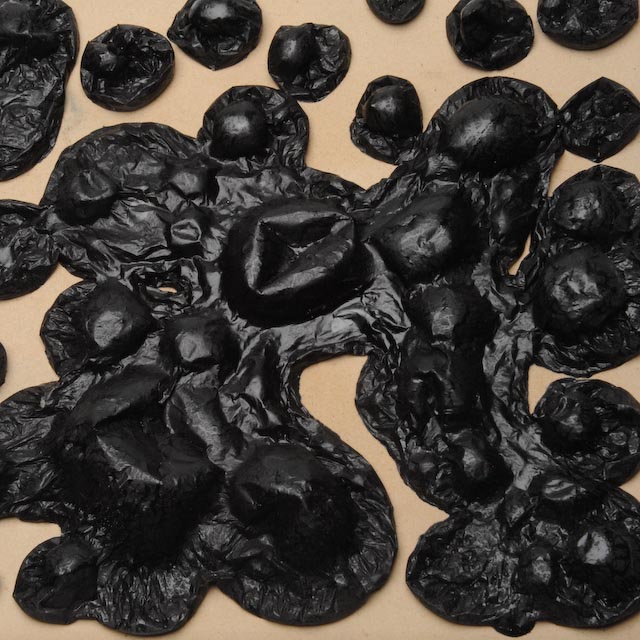
Working with the first test batch was very interesting. Although the body was very short, it had great green strength, which was definitely a plus point. I need to add something to increase the plasticity. During the firing process it dawned on me that with the high amount of fluxes, the temperature of 1150*C would be too high. The photograph at the top is the result, everything melted down and bloated totally. I am doing more test firings at lower temperatures, but will also experiment with other fluxes to come up with the perfect solution.

The next mistake I encountered was using platinum luster on an unglazed surface fired to a high temperature. What I envisaged as a bright matt silver colour, turned out to be a rather muted grey. Although not totally wasted,  I will not go this route again. The colour would be much better obtained from slips and engobes, as the price of the luster is too expensive to make it commercially viable.

So its back to the drawing board for me, even the smallest mundane pieces can stimulate your creativity, and hopefully great things will come from this

Friday, April 8, 2011

Trash Chic

What to do with your clay trimmings when you make your masterpieces? Instead of dumping it in the reclaim bin, (which is in most cases just a politically correct name in many studios, as it is a lot more convenient to buy a new bag of clay than slogging over the bin trying to reclaim the scraps) unskilled people are shown how to form it into these simple organic shapes.

Decoration comes from a pile of unused decals that clutter up another part of the studio. Larger motifs are treated as pieces of fabric that is cut when making a garment instead of trying to feature a realistic image. The effect is quite abstract and whimsical. Words and letters are cut up and reassembled to represent typeface, but please don’t try to attempt constructing a logical sentence from it.

These ‘Pretty Pebbles’ find their way onto leather, suede and organza, accentuated with a decorative bead, as an adorable funky piece of jewellery made from discarded materials. Judging from a few that survived having been accidentally dropped onto a concrete floor, they are very durable too!

If you just have to have one for yourself or if you want to stock a few in your store, contact Deon on +27(0)72 134 9613

Friday, April 1, 2011

Have a Heart

When I was invited to exhibit at the ʻOut of the Boxʼ Art Fair Extraordinaire, I decided to make a few heart shaped items for the occasion. With the proceeds of the fair going to the ʻOut of the Boxʼ Skills Development Centre, I decided the shape would be appropriate. The centre provide training to unemployed people to acquire basic craft skills in order for them to make items to sell as a way of sustaining themselves.

Why red? Suitably it is the colour of blood which pump through our hearts without which life would be impossible. Please support the artists exhibiting, proceeds go to a very worthy cause.

Art Fair Extraordinaire
Friday 1 April to Sunday 3 April
10H00 to 14H00 daily
305 Long Avenue
Ferndale
Randburg
Enquiries: Nina 083 583 5383

Tuesday, March 15, 2011

All that is broken is not lost!

FRAGILE Salt & Pepper Shaker 

This elegant sculpture is a ceramic salt and pepper shaker that comes in one piece and only by breaking it, you turn it into a useful product. The action of breaking leaves its mark on the shaker and you create your own, unique piece. It is very easy, and also very exciting!

The FRAGILE salt & pepper shaker is manufactured by StudioKahn in their small studio in Jerusalem. It was the first prize winner of Designboom's "dining in 2015" competition, competing against 5000 designers!

Mey and Boaz Kahn were born in Israel and live in Jerusalem. They met during their studies at Bezalel Academy of Art and Design, Jerusalem and got married after their second year. “Fragile” was the first project they were working on together.  They manufacture most of their products in-house in their studio and develop them through a process that begins with a practical research of the materials.

'Design, for us, is a field that lay on the border of art. We don’t believe that all of the products should be designed with the purpose to make our life easier or more comfortable. We want our design to surround its users with stories and emotions, hope and fantasies, questions and fairy tales. We believe that good design must reveal cultural issues and ask questions about our way of living.'